
Your bag is empty.
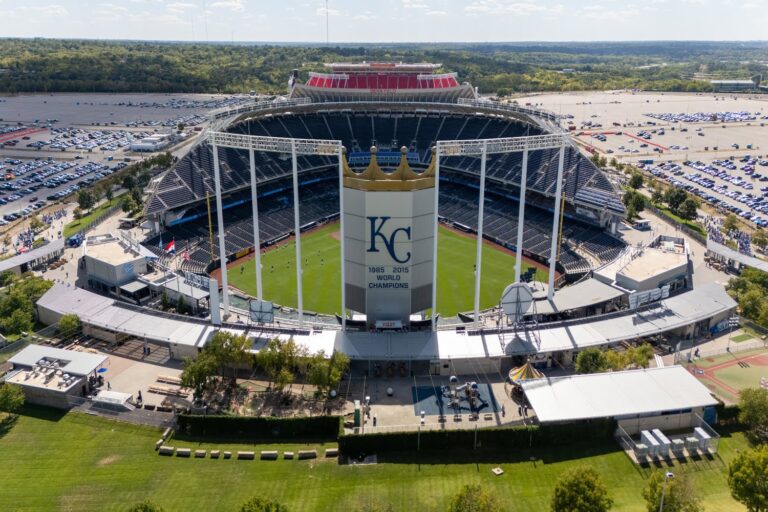
The Kansas City Royals are making a significant alteration to their iconic Kauffman Stadium, a move that could reshape the dynamics of their home games. Sources indicate the team plans to pull in the outfield fences by approximately 10 feet across much of the park, aiming to shift from a pitcher-friendly haven to a more of a launchpad for hitters.
For years, Kauffman has been renowned for its expansive outfield, the second-largest in Major League Baseball behind Coors Field. This design has favored speed and defense, favoring extra-base hits like doubles and triples all in lieu of suppressing home runs.
Hitters have often watched well-struck balls die on the warning track, leading to frustrations and potential adjustments in their swings. The Royals’ front office, recognizing this as a hurdle to attracting and developing power hitters, has decided it’s time for a change to foster a fairer environment where solid contact is rewarded consistently, whether at home or on the road.
GM J.J. Picollo emphasized the need for neutrality, saying: “We want a neutral ballpark where if you hit a ball well, it should be a home run.”
When you have stars like Bobby Witt Jr., Salvador Perez, Maikel Garcia, and Vinny Pasquantino anchoring the lineup, you want to get the most of out of the prime of their careers. Unfortunately, Perez’s career is deep on the back nine, but Jac Caglianone is positioned to be the next star for the Royals. All in all, I believe better days are coming down the pike for KC.
Details of the Kauffman Stadium Changes
The Royals’ plan involves targeted adjustments to Kauffman’s outfield dimensions. The fences will be moved inward by 9-10 feet in most areas, tapering toward the corners where the foul poles remain at 330 feet.
Power alleys, previously set at 389 feet, will shrink to 379 feet, while center field holds steady at 410 feet to preserve the beloved batter’s eye beneath the Crown Vision scoreboard. Additionally, the fence height will drop from 10 feet to 8.5 feet, potentially allowing for more dramatic home run robberies by outfielders.
This isn’t the first time Kauffman has made changes before. From 1995 to 2003, the fences were similarly pulled in, briefly making it a hitter-friendly park before reverting in 2004. The current project, greenlit after studies initiated in May, maintains symmetry across left, center, and right fields, ensuring fairness.
These tweaks are designed to eliminate the “dead zone” for fly balls, where environmental factors like wind and temperature have historically played an outsized role in minimizing the offense.
Why Did the Royals Move the Outfield Wall in at Kauffman Stadium?
The primary focus was to address Kauffman’s reputation as a home run suppressor, which has influenced player development and acquisition strategies. Picollo noted, “The second they start feeling like they can’t get the ball out of the ballpark, they start changing their swing. I watched it for years and years and years.”
Dr. Daniel Mack, the team’s Vice President of Research and Development, highlighted the analytical rigor behind the decision. By analyzing four years of climate data, wind patterns, and batted-ball trajectories, the Royals aim to align Kauffman more closely with league averages for fly-ball outcomes.
“What we wanted to focus on was how could we find dimensions that would create a more consistent approach for us as a team,” Mack explained, underscoring the shift away from extremes that force adaptations in player strategies.
Mack added that chasing extreme park factors isn’t sustainable, especially for a smaller-market team. “I feel like that’s just chasing lightning. I don’t think that’s smart in general,” he said. Instead, the focus is on adaptability, allowing the Royals to build rosters without overemphasizing pitcher-friendly or hitter-friendly biases.
Projections and Reactions to Kauffman Stadium Changes
Analysts project the changes could add about 1.5 wins per season for the Royals through improved home-game offense, without drastically harming pitching effectiveness.
Players like Perez might inch closer to 400 career home runs, while Witt could realistically hit 40 in a season—milestones potentially accelerated by the friendlier confines.
Other players like Pasquantino are really going to flourish, and he had a very animated response on X (Twitter), essentially saying that we will likely see more homeruns – but will that necessarily be better offense?
Pasquantino’s question is genuine on the surface because Kauffman Stadium does produce a lot of doubles and triples, and the latter could be phased out largely.
All in all, this is a situation that you certainly want to keep an eye before your fantasy baseball drafts this season. Players like Witt Jr. are going to be great wherever they play, but a lot of these other guys like Garcia and Pasquantino just got a major boost to their rankings.
Related Posts