
Your bag is empty.
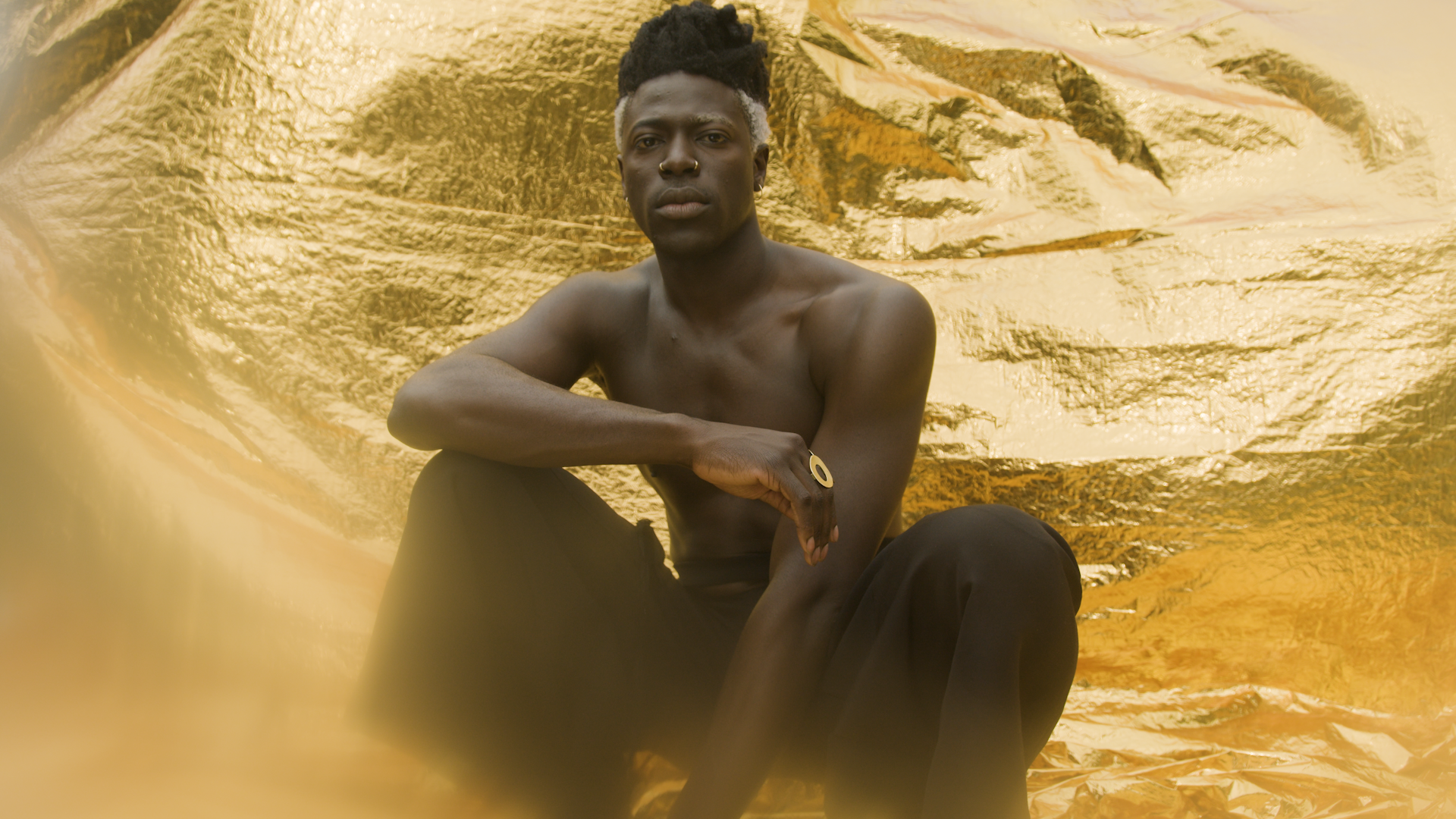
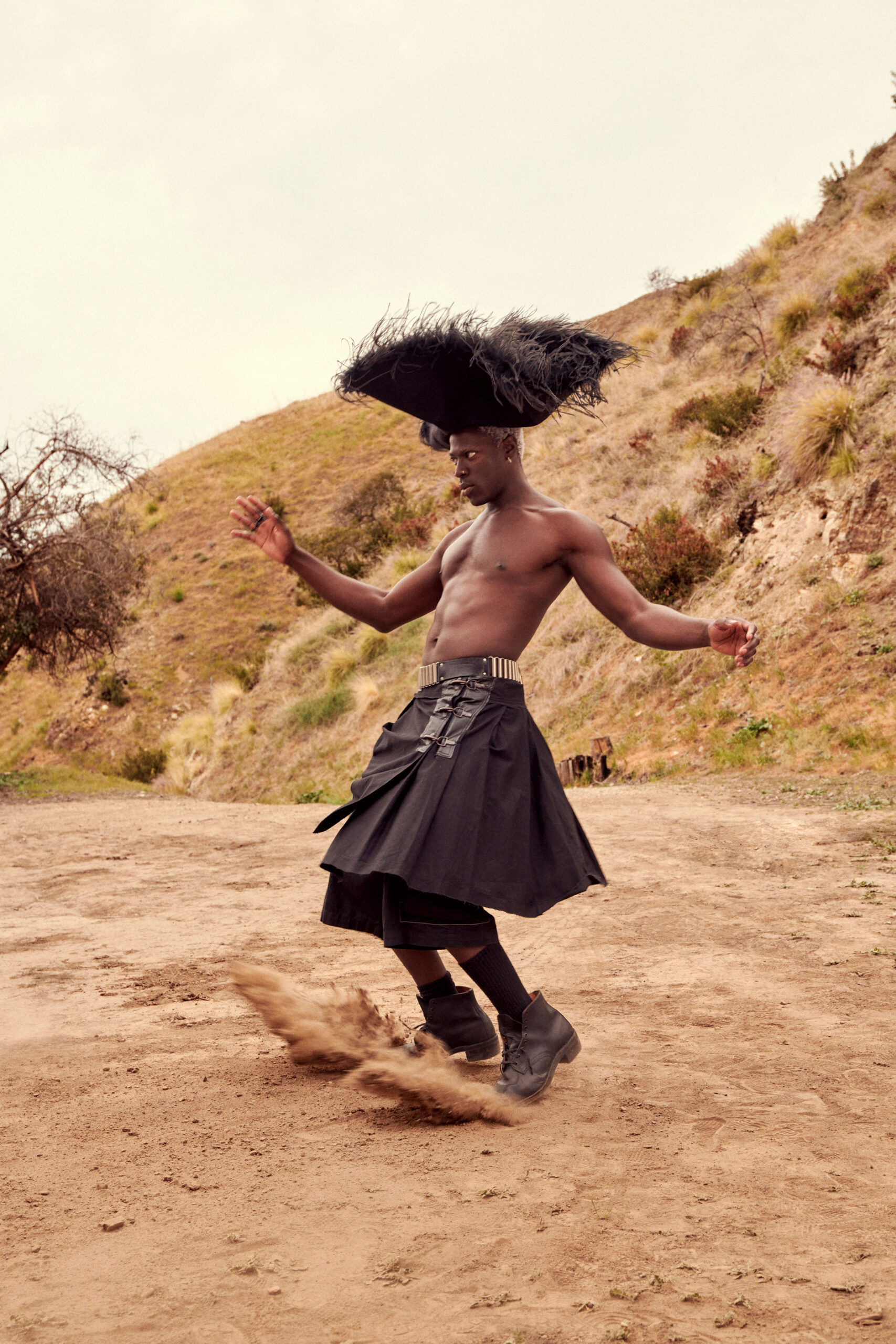
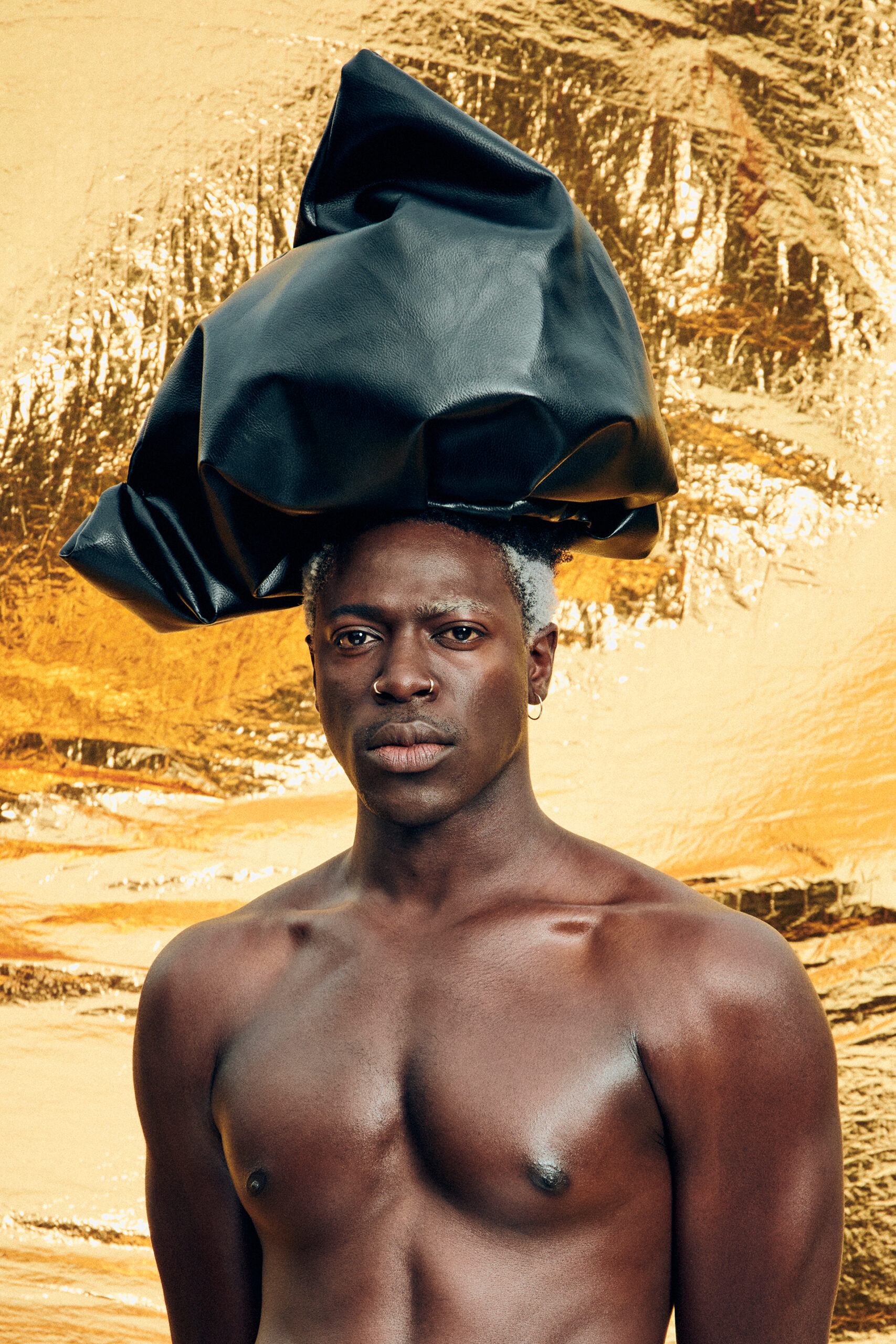
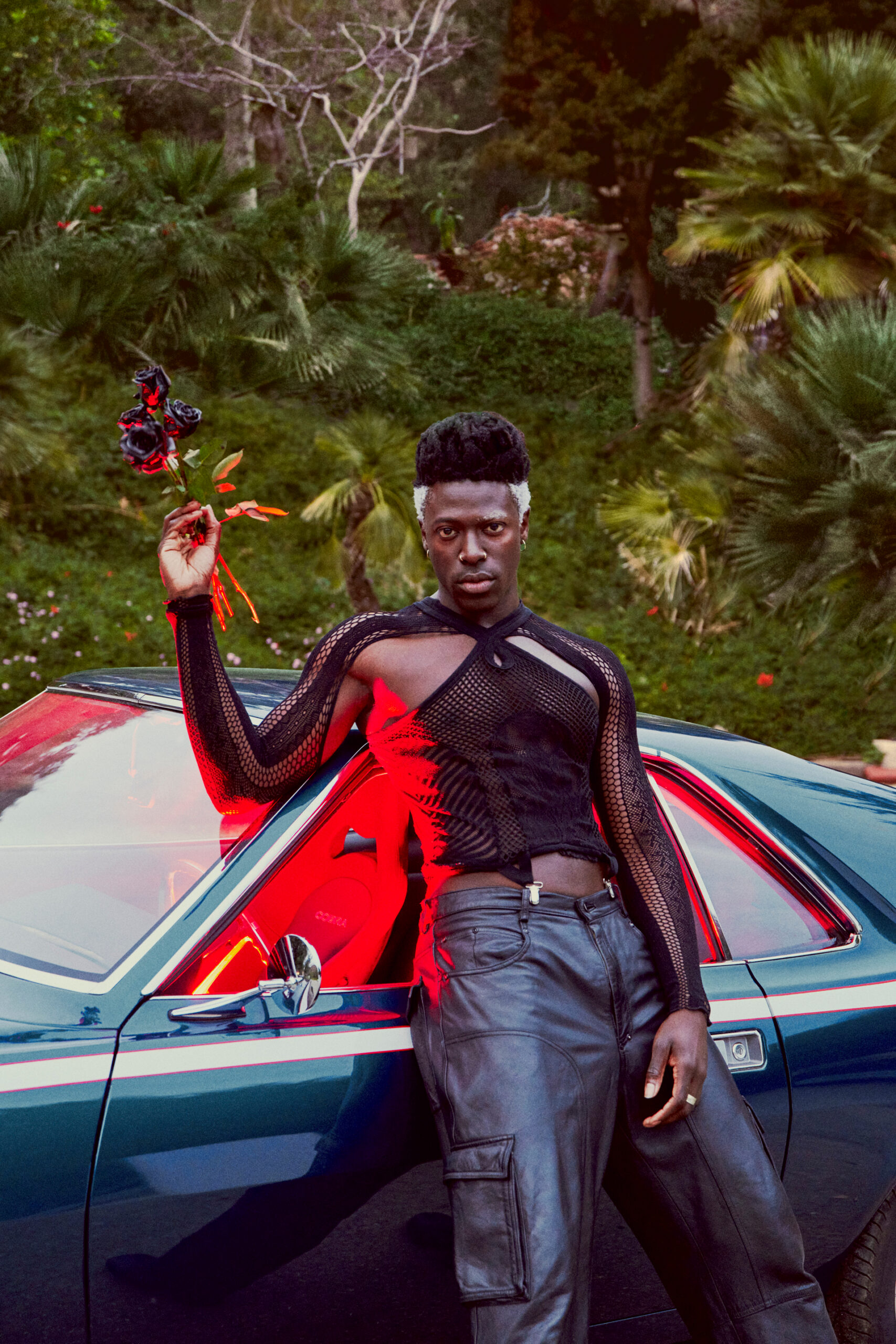
If he were a marble-hewn bust, Moses Sumney would be a masterpiece of plurality: bi-tone eyebrows, a jaunty loc crown, low-cut bleached-blond sides. Yet on this late-February day in Los Angeles, the very human artist is posing, leanly muscled and shirtless, in billowing black pants and an equally inky structural hat he jokingly observes resembles a gele.
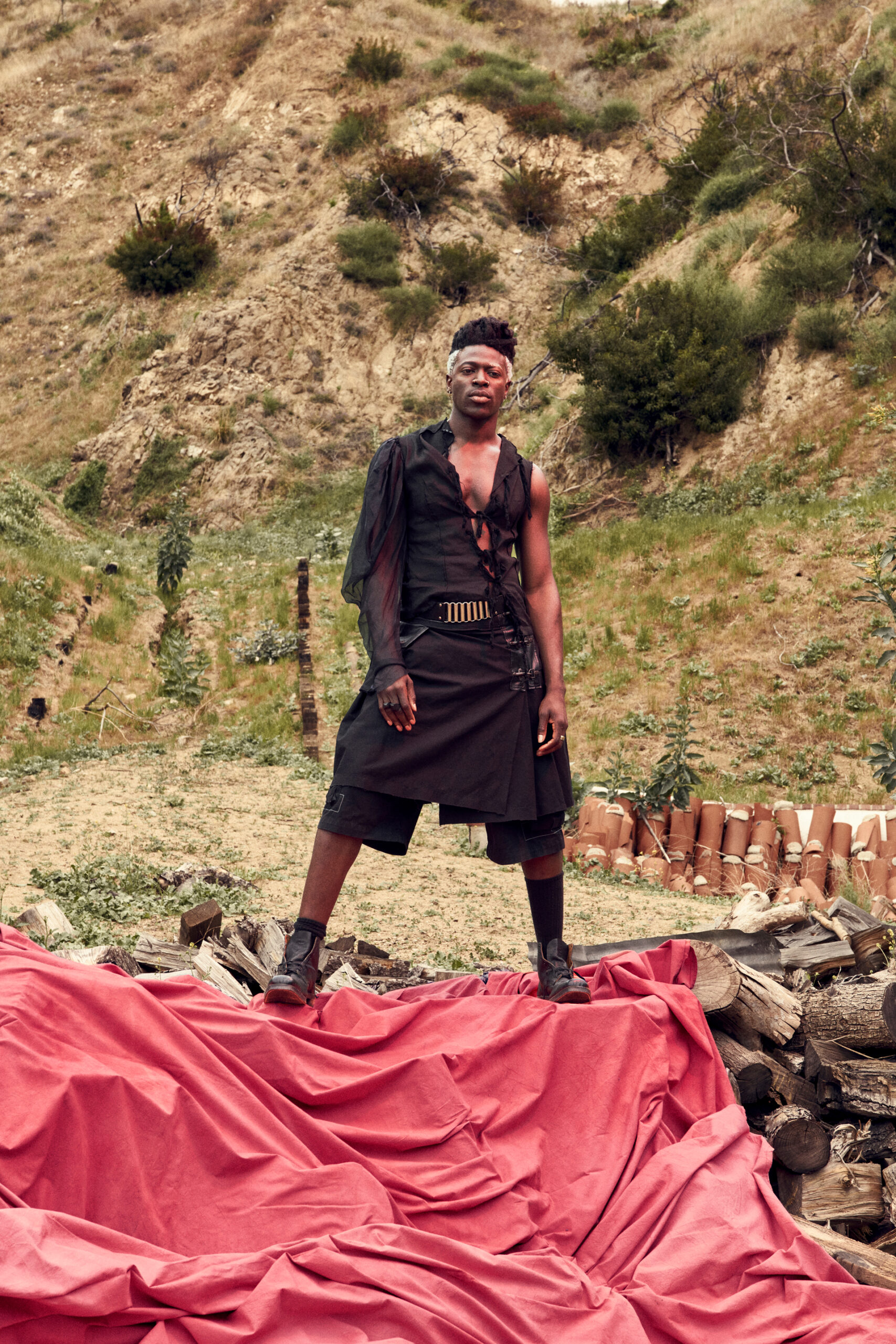
His figure contrasts dramatically with the verdant backdrop of stubby lemon and orange trees spaced precisely across the small field behind him. Moments earlier, he and a stylist flirted with the idea of a plumed pirate hat paired with a sheer shirt he described as “a bit too Renaissance fair,” though the accompanying nipple blockers piqued his interest. The deliberations echo Sumney’s high school years, when he was not yet brave enough to sport the goth looks he secretly coveted.
The child of Ghanaian immigrants—who he later learned entered the country without papers—Sumney now resides in Asheville, North Carolina, where, according to the artist, everyone is a bit weird so he fits right in. In 2018 and for a large portion of 2019, he was locked away in isolation (well before it was a transnational requirement) finishing his second album, Grae, half of which appeared early this year. Grae follows the critically acclaimed Aromanticism, released in 2017 while Sumney was still floating on the accolades from his 2016 EP, Lamentations. His 2014 breakout, Mid-City Island, is a bewitchingly nebulous EP created on a four-track cassette recorder gifted to him by Dave Sitek of TV on the Radio.
By 2015 Sumney seemed poised for a more traditional kind of stardom, appearing on the opening track of Beck’s album Song Reader and capturing the ear of fellow musicians James Blake and Solange, with whom he remains a close collaborator. He was seen as something of an indie darling by the major labels that courted him—a provocateur whose raw talent could be shaped into a more palatable idea of black indie artistry. He enjoyed the courting phase but ultimately turned down major-label offers in favor of Jagjaguwar, an indie label that has been home to Bon Iver, Unknown Mortal Orchestra, Sharon Van Etten and more. The label released Aromanticism and, on May 15, the full edition of Grae.
Weighing in at 20 tracks and just over an hour in length, the project is a sprawling, open-ended statement on liberation and existing in liminal spaces. Its themes are starkly evoked in the song “also also also and and and,” wherein Sumney intones, “I really do insist that others recognize my inherent multiplicity / What I no longer do is take pains to explain it or defend it.”
“I realized over the course of the record that I could do anything,” Sumney says, seated in a lofted alcove of the private home where the shoot took place, “and that the permission to do it is granted by me. So why not be audacious?” It’s a rhetorical question, but it raises another: Is Sumney’s audacity sustainable in an industry that tends to pay lip service to individuality while cramming it into boxes?
Much of the project’s narrative language is established through spoken vignettes courtesy of friends and creators such as author and cultural critic Taiye Selasi, writer and speaker Ayesha K. Faines, actor Ezra Miller, writer Michael Chabon and actress Michaela Coel. Their voices provide structural reinforcement to Sumney’s observations on the inherently fluid nature of cultural identity, gender identity and sexuality. Throughout the album, Sumney ruminates on how different modes of conforming to society can, if one has the courage, be deconstructed and then reconstructed to reflect personal truths in spaces of solitude.
“insula,” Grae’s opening number, begins with a looped, disembodied voice reciting “isolation comes from insula which means island” over a swelling string arrangement. For Sumney, who left his previous life in Los Angeles in 2017, the quietude of Asheville became exactly that—an island where he could freely reflect and, like a caterpillar in a cocoon, prepare for transformation.
“It’s hard to care what other people think when you’re not constantly confronted with it,” he says in a rich, slightly weathered alto. “Living in L.A. you’re constantly confronted with not only what other people think of you but your consciousness of what other people think of you. They might not be thinking anything at all, but you move in space in a way that you’re constantly confronted with your own self. Being less and less around people, I was constantly confronted with myself—but not myself to the eyes of others; just myself to the eyes of my own desires. I always seek to be honest in the work, and I felt the most honest thing I could do was follow those desires, which are rather varied.”
In the video for “Virile,” one of Grae’s lead singles, a shirtless Sumney dances through a meat locker, both taunting and fleeing from symbols of toxic masculinity with the abandon of a whirling dervish. It’s a fitting accompaniment to a song that mulls over the constructions of masculinity, rejecting its binding tropes over a soundscape of harp, flute, strings and bass (the last one courtesy of producer, Kendrick Lamar collaborator and low-end virtuoso Thundercat). Bombastic and theatrical but at times deeply introspective, Sumney’s voice acts as a liquid binding agent, melding the instrumentals into a cohesive waking dream, or nightmare, for those enmeshed in the performance of maleness.
“I’m actually getting back into it,” Sumney says. “Masculinity, when it’s positive, is sick as fuck. Unfortunately, the toxic version of it is what reigns on the earth. It’s important to understand that there is masculinity and femininity in everyone, if you choose to identify with those two things. There are people who don’t with either, and that’s fine as well. I just think it’s a natural part of the earth that they both exist. So now I’m just trying to think, what are the positive forms in which masculinity can exist? Sometimes masculinity is in women, and sometimes it’s in men. It’s the same thing with femininity, right? So now I’m like, ‘Oh cool, I actually quite like being a man.’ As long as it’s not oppressive.”
Such observations play into Sumney’s larger thesis: We should all be free to exist in gray areas and to bend the rules in the same way those with structural privilege have always gotten away with doing. “In terms of who gets to bend the rules, it’s foremost white men,” he says. “It was fascinating to me how a lot of the tropes for how a man is supposed to act come from mainstream white society, but also the people who are forgiven the most for breaking those rules are then white men.”
He goes on: “Growing up—not just in an African household, because it applies to black Americans as well—and thinking about the structure of the performance of masculinity and how much I could bend it, or weave in and out of it, was a process of unlearning. I think a big part of the unlearning was being like, Well, [white men] are doing it, so why the hell can’t I? Your life might be harder, but you do have the choice.”
Existing authentically outside assigned spaces, potentially sacrificing ease and profit, has no doubt complicated Sumney’s career, but it has also given him a gift: the ability to grow and learn without the obstruction of others’ expectations. Not everyone receives the gift, as he recently reinforced in a lengthy Twitter thread highlighting the many indie black artists (a number of them queer) he felt deserved more recognition.
Sumney’s position brings forward an interesting dichotomy: On the one hand, popular music often embraces expressions of fluidity. From Prince to Freddie Mercury to Patti Smith, there’s a long line of mainstream artists whose experimentation with ideas of gender and sexuality are inherent in their personal and professional identities. But their existence is the exception and not the rule—doubly so for non-white artists, many of whom are pigeonholed by the expectation that they adhere to tropes associated with prevailing ideas of “black music.”
The weight of such implications is more than theoretical. It’s genuinely difficult for left-of-center emerging talents to find ways to meaningfully take up space—to navigate their careers authentically when carving out said space is contingent on assimilation. Whether it’s Sumney or an artist like K. Michelle, who gained prominence as an R&B singer purely because she was dissuaded from marketing herself as a country artist, we constantly see this conflict at work. More troubling, perhaps, is how easy it often is for white artists to move outside this framework, effortlessly shifting between identities, genre delineations and more, completely oblivious to the fact that their peers of color are rarely extended the same grace.
Masculinity, when it’s positive, is sick as fuck.
“There’s the simple fact that once you do something in the world, it’s like the world expects you to do it forever,” says fellow musician Shaun Ross, whose albinism made him an uncommon face in the modeling world. Ross is transitioning into a music career, but he’s finding that his history as a model and his experimental sonic aesthetic are often difficult for mainstream audiences to reconcile. Like Sumney’s music, Ross’s funk- and futurism-inflected sounds underlie queer experiences while defying easy categorization. Although his music has earned him a devoted fan base, it has also created hurdles in his efforts to infiltrate more mainstream music spaces.
“People must understand that before anything we are artists,” says Ross. “We should all be able to have this freedom of expression that isn’t attached to the need for labels, whether that be in regards to gender, race, sexuality or anything else.”
Grae does not ask permission to do what Ross describes: create in a multitude of ways, all of which are true to the artist. Sumney’s approach feels infinitely more exciting than dialogues that seek to make concrete constructs of the amorphous. “We have identity, and then identity on a national scale, and those conversations can be really porous and really shallow, and are really kind of boring,” he says. “Everyone is just saying the same thing over and over. Whether they’re on one side or the other side, it’s just two sides of things. In a way, I didn’t want to talk about it, because then I’d still be talking about identity. But it was honest to this project.”
Sumney also leaned on his cross-cultural and cross-continental upbringing as inspiration for Grae. The upheaval of living between drastically different worlds produced a feeling of statelessness but also an understanding of how identity as it relates to nation, gender and even sexuality feels absolute only in certain environments—and why conversations around community and belonging can be myopic.
“I was thinking about what it was like growing up on both coasts—on the coast of Africa and the coast of America,” he says. “It made me think about how the foundation of my personality or identity is displacement, and where that comes from. I’ve been thinking more about feeling displaced, and that maybe I like different kinds of things because my life has been a mix of a lot of genres and I never fully welcomed any of them.”
Like Sumney, Ghanaian American musician, singer-songwriter and engineer Amaarae grew up between Ghana and the U.S. Her music is also grounded in the exploration of identity. During time spent in Atlanta, she devoured Southern rap. In predominantly white suburban New Jersey, she discovered alternative and post-punk. Today the singer’s falsetto croonings draw parallels to Esther Jones, the Roaring Twenties black jazz singer who was the inspiration for the character Betty Boop. Echoing Sumney’s ruminations on both romantic and aromantic love in projects such as Passionfruit Summers, which features her 2017 single “Fluid,” Amaarae challenges ideas of femininity, juxtaposing a babyish voice with an often androgynous presentation.
“The concept of fluidity can mean so many things,” she says. “For me the idea of fluidity transcends what people typically associate it with, which is sexuality or gender. I actually think adaptation is a form of fluidity, and I guess that’s something I’ve always experimented with. Living somewhere like Smyrna, Georgia and wearing Hot Topic to me is fluid. Kids were wearing Jordans and Iverson jerseys and I’m wearing goth clothing, and they’re looking at me like, What the fuck? But pushing those boundaries and setting off those ideas in people’s heads of what it means to live in your identity—all those things are important to me in my music and in my life.”
While living in Los Angeles, Sumney similarly found himself questioning what it meant to take on an identity, more specifically one tied to blackness.
“I’d spent years trying to build community with people,” he says. “This is actually way too honest, but I don’t care. I actually found that for me, building with people, especially black people, I sometimes had to do it in ways that felt unnatural. Unnatural only because in order to be accepted, I had to shave down things about myself, shave down things about my personality, get rid of certain types of friends so I would be liked. I felt that was a necessary sacrifice, because it was important to me, and still is, to have community with black people and uplift black people. Then I was in isolation, and I was like, Oh, now I’m in community with the trees and birds and squirrels!”
He allows a laugh and dives back in. “I had time to think about why we create these structures. Why do I have to pledge allegiance in a way that minimizes my individuality? I kind of started to rebel, and in diving deep and thinking about it all I still realized how necessary it is for people to have community, especially people who are marginalized and rejected by mainstream society. Community was and is a protective measure, and I think it really helped me empathize a lot better, even if the ways they built community can be unhealthy and damaging.”
For all his talk of isolation and individuality, Sumney finds himself making a case—a characteristically complex one—for community. That would explain Grae’s cast of contributors. It’s an irony that reveals itself the more you listen: Without that range of voices, the album would feel less unified. This is the force that pushes Grae beyond a testament to solitude or an exploration of mere duality. Sumney’s world contains as many sides as we need in order to encompass our true selves—emotionally, romantically, physically and beyond.
In a way, it’s a self-effacing move made by a unmissable man, an openness he hints at as he explains his thinking behind that patchwork of spoken interludes.
“I knew I didn’t want to talk on the record,” he says. “I knew I needed a way to tie the songs together, because sonically the songs are just so disparate that they needed to blend into each other in order for it to feel like a cohesive experience. And then with those interludes, it was like, Okay, well—people need to talk.”