Your bag is empty.

A candid conversation with the outspoken congressman about angry Republicans, gay marriage, his personal scandal and the price of impeachment
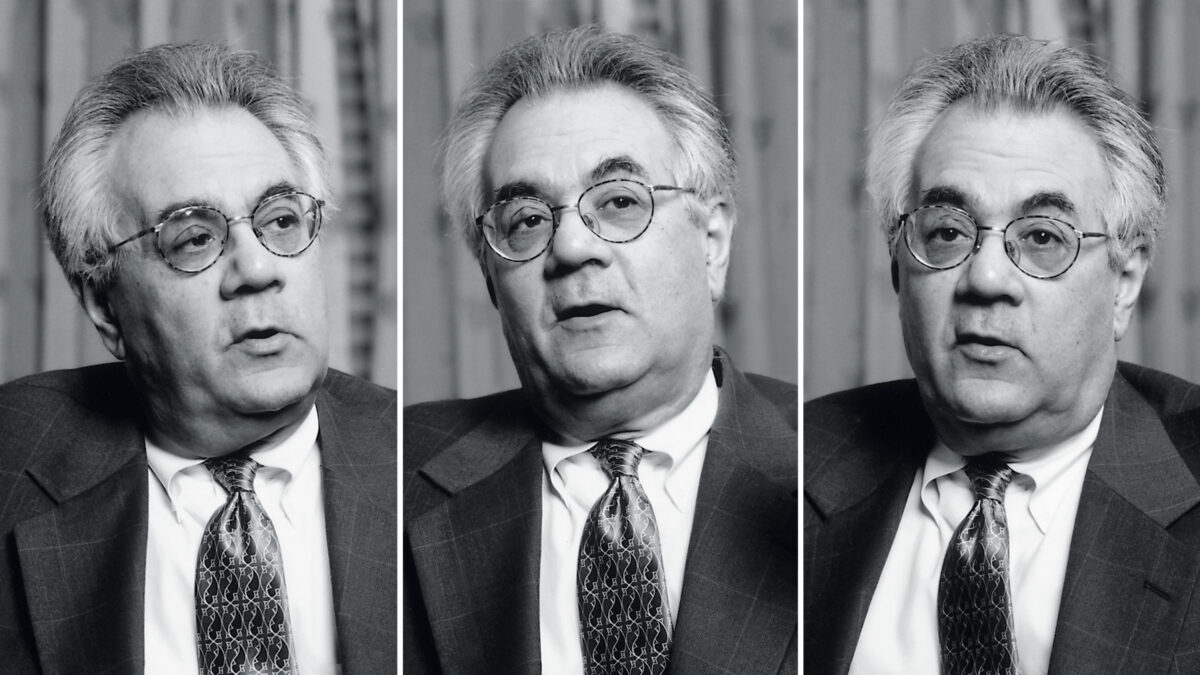
It’s a typical, though unglamorous, day at the Newton, Massachusetts office of Congressman Barney Frank. In the outer office it’s standing room only for the eclectic collection of Frank’s constituents and representatives of special interest groups awaiting an audience. One man is here to ask for Frank’s help in convincing the Congressional Black Caucus to support his project, the American Antislavery Group. A distraught woman says she wants federal protection because of a domestic problem involving a child.
One by one, they are escorted into a conference room where Frank holds casual court. The meetings are brief—five to ten minutes—after which the visitors are led out, apparently satisfied. The distraught woman is one exception. She is sobbing as she is guided from the congressman’s office. “He’ll do what he can do,” her friend consoles. The crying woman isn’t convinced and utters a homophobic remark.
Following the meetings, Frank throws on his suit jacket and overcoat and heads out of the office, trailed by a documentary filmmaker with a camera. As the congressman passes her desk, one of his assistants chuckles. “It’s nice to see Barney with an entourage,” she says. “He never gets to have one.”
Soon Frank is behind the wheel of a rented sedan, driving through Boston on his way to meet with a group of hospital administrators concerned about recent Medicare cuts. Changing from one freeway to another, the car hits a bottleneck and is forced to inch along slowly. Frank swears under his breath. “I can’t believe this traffic,” he says. He doesn’t laugh when one of his passengers suggests he write his congressman.
It’s a far cry from the picture of him that is familiar to many Americans: Frank in congressional hearings railing eloquently against the Republican accusers of President Clinton, an image televised throughout last year’s impeachment hearings. Indeed, although Frank has been a congressman since 1981 and is considered a prominent and effective legislator on domestic and international issues, he gained immense visibility outside his home state of Massachusetts during the hearings. As the second-ranking Democrat on Chairman Henry Hyde’s House Judiciary Committee, Frank was one of the most visible congressmen—loved or loathed, depending on the viewer’s opinion about the impeachment.
Though Frank was a harsh critic of the partisanship that characterized the debate leading to Clinton’s impeachment, he was in his element in the contentious hearings, trading witty barbs with his adversaries across the aisle. (Early on he described the hearings as “an impeachment in search of a high crime.”) He was a thorn in the Republicans’ sides, arguing about everything from procedure (for example, he wanted deliberations to be open to the public) to whether the president could be censured instead of impeached. Outside the hearing rooms, Frank was an architect of the Democrats’ strategies. When some of his colleagues pushed for expanded hearings that would have included witnesses to support President Clinton, Frank’s view prevailed: “When your opponent is busy committing suicide, get out of his way,” he said.
Though it put him at the center of the year’s biggest story, the impeachment was by no means Frank’s first time in the middle of controversy. As America’s first openly gay congressman (he came out in 1987), Frank is often in one storm or another, many of them connected to gay issues. When he compromised on gay-related legislation, he was condemned by gay-rights groups; when he pushed gay rights, he was attacked by conservatives. While all politicians are attacked for the stands they take, some of the vindictive attention Frank received was directed at him because he is gay. In 1995 Dick Armey called Frank “Barney Fag,” claiming later that it was easy to confuse “Frank” and “Fag.”
But Frank is hardly a one-issue legislator. Since arriving in the House in 1981 after eight years in the Massachusetts state legislature, he has taken strong, mostly liberal stands on issues that include gun control, the North American Free Trade Agreement, affirmative action, the death penalty, workers’ rights and the International Monetary Fund. He is fiercely pro-choice and pro-welfare. (He once said of his adversaries on the first of those issues: “Sure they’re pro-life. They believe life begins at conception and ends at birth.”) His current causes include a reduction in military spending, a universal health care system in America and what he calls an “international New Deal” that would strengthen America’s position in the emerging global economy.
Frank also suffered a personal scandal that preceded Clinton’s by a decade. It stemmed from his 1985 relationship with a male prostitute named Stephen Gobie, whom Frank befriended and employed as a housekeeper and driver. Gobie later betrayed Frank, claiming he had operated a prostitution ring out of Frank’s home with the congressman’s knowledge. There were calls for Frank’s resignation. Frank, by then living with an economist named Herb Moses, had thrown Gobie out when he was alerted to the illegal activities by his landlady. He contested the allegations in the House Ethics Committee and asked for an investigation, which found no evidence that Frank knew about the prostitution ring. He was nonetheless officially reprimanded by Congress. (At the time, Congressman Newt Gingrich pushed for the more serious punishment, censure.)
Despite the scandal, Frank ran again and was handily reelected. Since then, he has become one of the most powerful, highest ranking members of the House, serving on the most important committees, including banking and judiciary. His congressional seat is so firmly sealed that he ran unopposed in two of his last three elections.
Frank, who was born in Bayonne, New Jersey in 1940, was interested in politics at an early age. He is one of four children (his sister Ann Lewis is Clinton’s communications director), and when he wasn’t in school, he worked part-time at his father’s truck stop. But he also read voraciously—news as well as literature—and was always sensitive to social injustice. It was his early glimpses of racism and bigotry that led him into politics.
He studied political theory at Harvard and planned to pursue a Ph.D. but left academe for politics in 1967, when he went to work for a Boston mayoral candidate. In 1972 he ran for office for the first time and won a seat in the Massachusetts House of Representatives that he kept for eight years. He ran for the U.S. House in 1980.
Frank was an enormously effective legislator, popular with his constituents and many of his peers in the House. He earned a reputation for his skills as an orator and is often referred to as the smartest man in Congress. He made history when, in 1987, he told a Boston Globe reporter that he was gay, explaining, “I don’t think my sex life is relevant to my job, but … I don’t want to leave the impression that I’m embarrassed by it.” In the election that followed, his opponent attempted to make Frank’s personal life an issue (at the time he was living with Moses, though the couple has since separated and Frank is now single). The incumbent won 70 percent of the vote.
In the aftermath of the impeachment, immediately after the Senate voted to acquit Clinton, we sent Contributing Editor David Sheff to meet with Frank. Here is Sheff’s report:
“Frank is famous for his frumpiness. In 1976, running for reelection to the Massachusetts House, one of his campaign posters read Neatness Isn’t Everything. So I was surprised by his tailored dark suit, recently pressed. But nothing else about Frank was polished. In fact, his casual style and unpretentiousness—even the fact that he drove himself around town—made him seem like an oddity in Congress. For a politician he is also unique in that he seems unswayed by opinion polls.
“The most instructive forum in which to watch Frank is not in televised hearings but in his meetings with constituents and numerous special interest groups. When he met with the group of hospital administrators, he was clearly knowledgeable about such issues as HMOs, prescription medicine and Medicare. Frank listened but was also quick to point out contradictions and hypocrisies in the arguments of others. Immediately after that meeting, he had scheduled yet another face-off with voters. ‘Now that we don’t have to waste our time on the Lewinsky—Clinton scandal, the American people expect us to get on to some real issues,’ Frank said at one point. ‘I, for one, think they deserve that.'”
PLAYBOY: After the impeachment ordeal, are you feeling discouraged?
FRANK: I was discouraged in August—the whole thing was sort of messy and unpleasant. But now I’m less pessimistic. In fact, it was heartening to watch the American public through all this. They behaved enormously well. It was a delight to watch them.
PLAYBOY: Are you referring to the public’s consistent support of Bill Clinton throughout the impeachment process?
FRANK: It was that the public refused to be told what to think. They ignored the experts, including the media. Ordinarily the public is instructed on their politics, because they feel they lack expertise in many issues, whether science, economic or environmental issues or complex foreign policy. But they knew what this was about. A married man had sex with someone he shouldn’t have had sex with. She worked in his operation, it was consensual. There was nothing about the Clinton—Lewinsky affair that required experts. And the public quickly made up its mind. That drove the press and most of the Republicans wild.
PLAYBOY: As a result of this scandal, are politicians’ personal lives fair game or verboten?
FRANK: The public was clear on this. There is a sphere of privacy that they respect. Throughout the scandal, they weren’t simply reacting against the Republicans and for Bill Clinton. They reacted against the voyeurism. Ken Starr became the first wildly unpopular prosecutor I can think of. Prosecutors tend to be the good guys, heroes. But Starr was one of the most unpopular political figures in American history, and not because people wanted to let Clinton off the hook. People felt that Clinton looked kind of cheesy in all this, but they correctly understood that the force behind the anti-Clinton effort was far more insidious. That force represents the people in this country who want to tell the rest of us how to live—how to make the most intimate and personal choices in our lives: how to worship, whom to love and when and where and how we may do it. The public said no. Americans viewed Starr—correctly, I think—as the agent of this, and Americans saw that it was both ridiculous and dangerous.
PLAYBOY: But Republicans maintained the impeachment wasn’t about sex.
FRANK: Though they said it wasn’t about sex, the Republicans spent an awful lot of time talking about the philandering S.O.B. They were mortally offended. It was all about sex.
PLAYBOY: They claimed it was about lies.
FRANK: The American people didn’t even care about the lies. A lot of them said, “We expect you to lie about sex.” In matters that aren’t their business, they don’t want to be told the truth. They don’t want to know every detail of a person’s life. We all know someone who has done something like what Clinton did. In everyone’s circle, among all of our family and friends, there has been a betrayal, a failure to live up to the moral code. Most of us have learned that life goes on. People thought, If I have to throw Bill Clinton out as president for this and apply the same standard to my life, I can never speak to my brother-in-law again. My nephew can never come to Thanksgiving dinner. This is about families who don’t speak to one another. This is about intolerance and lack of forgiveness—if someone screws up, saying, “Don’t ever come to my house again.” It’s the stern father who, when his daughter shows up after having had a child out of wedlock, turns her away in his self-righteousness. That’s not the way most people want to live. We may criticize, but we don’t judge so harshly that which is completely human. The public understands human complexity.
PLAYBOY: Were the Republicans simply out of touch?
FRANK: They were so out of touch that it was astonishing. They acted stupidly throughout the impeachment and afterward. There’s nothing more frustrating than winning a contest with a good loser. On the other hand, it’s wonderful to win when there is a bad loser. And the Republicans were the worst losers imaginable, snarling and unhappy.
PLAYBOY: If private lives are no longer fair game, at least according to the public, why did Bob Livingston have to resign his seat in the Congress when his affair was revealed?
FRANK: The fact is, three Republicans were shown to have committed adultery, and they acknowledged it and paid no political price whatsoever. Livingston was a separate case because he was running for Speaker. The electorate didn’t care—he wouldn’t have been hurt in his home district—but some of the right-wing Republican members of Congress would have stopped him from becoming Speaker.
PLAYBOY: Are you suggesting that he was pressured to resign—that he didn’t resign on his own in an attempt to take the high ground?
FRANK: He was pressured, pure and simple. Livingston was told he wouldn’t get elected as speaker. He was told there were enough Republicans against him—it would have taken only six—to make it a fait accompli. Despite their saying that the impeachment wasn’t about sex, there were enough Republicans who had condemned the cheating, adulterous Bill Clinton that they couldn’t then go ahead and vote for Livingston. But the other Republicans who admitted having adulterous affairs paid no price. Hyde, Chenoweth and Burton have had their elections and paid no price—even when there was hypocrisy. When the report about Hyde’s affair broke, it engendered more sympathy for him than criticism. It’s another example that negative politics no longer works.
PLAYBOY: Yet some Republicans—Dan Quayle, for one—are volunteering, even bragging, that they have been faithful to their wives.
FRANK: Yes, and that will hurt them. It is demeaning and injects an issue that people think shouldn’t be injected.
PLAYBOY: Livingston was a victim of Larry Flynt’s campaign of fighting fire with fire. Do you support it?
FRANK: I think there is something to be said for using people’s hypocrisy against them. In Livingston’s case, I don’t see that there was that much. He wasn’t one of the people who exploited the Clinton affair. But I understand the instinct to fight fire with fire. On the other hand, I’ll be happy when revelations about personal lives are dead and buried.
There is prejudice toward gay and lesbian people based on misunderstandings about us. It’s important for me to speak openly about my sexuality to help educate people.
PLAYBOY: Throughout the impeachment, the Republicans maintained that they were following their consciences, which is why they didn’t bend to public pressure. Were they?
FRANK: Nonsense. That was an after-the-fact rationalization. For years the Republicans argued exactly the opposite–that the left was out of touch and that Republicans represented the public. They said the Democrats, especially the liberals, arrogantly ignored public opinion about issues like the death penalty, affirmative action and welfare. They made a big point of saying how much they represented the public and chastised the Democrats for being uncaring about public opinion. Suddenly they’re arguing that it’s a good thing not to care about public opinion.
PLAYBOY: Were they surprised by the public’s reaction?
FRANK: Completely. They thought impeaching Bill Clinton would be very popular. They were planning national TV ads about it. They thought this scandal was going to be the end of Clinton and great for them. Throughout the impeachment, even when it wasn’t working, their strategy was to try to turn public opinion against Clinton. If they didn’t care what the public thought, why did they release grand jury testimony on television? Why did they want Monica Lewinsky on the floor of the Senate? They kept hoping that something they did would turn around public opinion.
PLAYBOY: At some point wasn’t it obvious that the strategy wasn’t working?
FRANK: That’s when they tried to hide what they were doing as much as possible. They said, “We’re going to vote to impeach Bill Clinton, but it doesn’t really mean he’ll be impeached.” They said, “The public doesn’t have the right to watch our debates and to know exactly where we stand.” They were afraid by then of having to pay the price of their so-called moral convictions. To allow the membership to hide from the public is a violation of democracy–which is exactly what they did. But in the end, the public spoke. They knew the impeachment was being used as a political tool, not as the founders had meant for it to be used. The truth is, they knew that the main sanction for the kind of flaw Bill Clinton showed was not impeachment but the election process. In a democracy, the main way you penalize elected officials is not to vote for them.
PLAYBOY: But Clinton can’t run again.
FRANK: That’s right, and the problem with a second-term president is that there is no way to punish him in an election. If there were, I don’t believe he would be reelected. It’s one thing to keep the guy in office; it’s another to reward him with another term. But since they couldn’t vote him out of office, the Republicans were frustrated. So they tried to circumvent the political process. In that, Americans saw who really controls the Republican Party. They saw that the right wing controls the party and they saw that the right wing is nuts. It’s not just that Jerry Falwell is nutty, with his compulsion to be a public moron, attacking Teletubbies one week and the Antichrist the week before. But Americans now understand just how obsessive and mean this right wing is. They also understand that the right controls the Republicans. There had been a misconception that the Republican Party was generally free of that ultraconservative influence. The mask was stripped off.
PLAYBOY: Did you know that the right-wingers controlled the Republicans so thoroughly that the party would allow them to destroy it?
FRANK: I actually thought that self-preservation would keep them from impeaching the president as late as early September. I really thought they would stop it when they saw how unpopular it was. So I underestimated not just the self-destructive tendency of the right wing but also the inability of the rest of the Republican Party to do anything about it. I guarantee that there were Republicans who wanted the process to stop a long time before impeachment, but they were powerless. They watched it unravel and were helpless.
PLAYBOY: Do you think more-moderate Republicans would have voted with you, against impeachment, but that they were blackmailed? Would the party have withheld money for reelection campaigns?
[A] Frank: They were blackmailed with votes, not money. Liberals always think it’s about money, that they are going to be unfairly outspent. Money is a factor, but a much smaller factor than the right wing’s organization. They get out the vote. Mainstream Republicans have more money than right-wing Republicans. The mainstream are the rich people, but they don’t get out the vote. So moderate Republicans were in a quandary. They felt they couldn’t break from the party because they would have been targeted by the right wing.
PLAYBOY: Was it subtle or overt pressure?
FRANK: It was overt pressure. Some of it was public. Bob Livingston, when he was running for Speaker, said that anyone who voted against them on the procedural issue involving censure would be defying the leadership. What that means is that you might have trouble getting a subcommittee chairmanship, or that you wouldn’t have leadership support in getting projects approved for your district. It was not subtle pressure.
PLAYBOY: Some Republicans maintain they wanted to vote for censure but were not given that choice.
FRANK: Yes. They’re saying, “They wouldn’t let me vote for censure.” You wouldn’t let you vote for censure. These people helped the Republican leadership prevent censure and then used the fact that they couldn’t vote for censure as an excuse to vote for impeachment.
PLAYBOY: Some of the Republicans felt that censure was too mild—a slap on the wrist. In one memorable speech, you argued that your reprimand by the House was indeed a big deal. Was that an emotional speech for you?
FRANK: It was very emotional. I thought censure was a way to break the country out of this miasma. I thought censure was appropriate. The anticensure arguments were totally inconsistent. They maintained that censure would cripple future presidents because it can be used so easily. At the same time they said that it doesn’t mean anything. But how can something that doesn’t mean anything cripple future presidents? So I made an argument against the suggestion that a reprimand like censure was meaningless. I also wanted to point out the hypocrisy surrounding Gingrich. If they cared so much about lying, why did they vote him a new term after his investigation? Under House rules, I couldn’t mention Gingrich’s reprimand on the floor, believe it or not. I knew that if I pointed out the hypocrisy, I could be ruled out of order. It occurred to me, however, that if I mentioned not only Newt Gingrich but also myself, it would be hard for them to rule me out of order.
PLAYBOY: Why couldn’t you mention Gingrich’s reprimand?
FRANK: We have rules that protect us. I can get up on the floor of the House and say outrageous things about anybody in the world except another member of the House and Senate. We can lie with impunity about anybody else, but we can’t tell the truth about one another. So I spoke about my own experience in order to address the hypocrisy around Gingrich and to show that reprimand is meaningful. They always knew that censure was meaningful, by the way. They, like me, care about this place–the United States Congress. To be reprimanded by this body is no small thing.
PLAYBOY: When your scandal broke, did you lie about it?
FRANK: Not under oath, but I did lie in a letter I sent to a friend. I lied about how I met Gobie [the central figure in the scandal]. I didn’t lie in any judicial proceedings like Gingrich had, but I nonetheless regret what I did. It was irresponsible. I was terribly afraid that it would damage gay causes. Ultimately it wasn’t as bad as I’d feared, but it hurt some. So I had political motivations in bringing up my past transgressions, but also personal ones: It was another way of expiating my mistake.
PLAYBOY: In retrospect, did you handle your scandal any better than Clinton handled his?
FRANK: Given that it happened, I reacted about as well as I could have.
PLAYBOY: There were calls for your resignation. Even The Boston Globe, which had supported you, wanted you to step down.
FRANK: Yes. The Globe had a brief Puritan period.
PLAYBOY: Was there ever a chance you would resign?
FRANK: No. There was a good chance I wouldn’t run again, but I never considered resigning. The reason is that it would have ended the House ethics proceedings. I knew I had done something stupid–and wrong–in engaging Gobie and keeping him around and getting involved with him to the extent I did. But I also knew that most of what he accused me of–letting him run prostitution in my apartment, among other things–were lies. The only forum in which I could prove that was the House Ethics Committee. If I had resigned, it would have ended the proceedings and I never would have been able to prove my innocence on those charges. But I did decide I didn’t want to run again. By this time I was living with my lover, Herb Moses, who told me I should run. He said, “You’re going to be a mess if you don’t run again.” But I was afraid I’d lose the seat for the Democrats, and that I would be doing more harm than good. Finally I agreed to poll my district to determine whether or not I should run. The results were that I should: People thought I had behaved stupidly, but they wanted me to run.
PLAYBOY: Was the public served in any way by knowing about that scandal?
FRANK: No, though it’s important that people know I’m gay.
PLAYBOY: Why is your sexuality an issue?
FRANK: Because there is prejudice toward gay and lesbian people based on misunderstandings about us. You don’t go from a prejudiced situation to an unprejudiced situation without knowledge. So it’s important for me to speak openly about my sexuality to help educate people. Forty years ago, when there was a lot of anti-Semitism, it would have been important for them to know that I’m Jewish. Today it is not a big deal that I’m Jewish. Where there is prejudice, it is important to be open. Then people can see for themselves that their prejudices are unfounded. It is important for gay people to let the rest of society know the fact of discrimination and the pain of discrimination. Even the Gobie stuff helped in a sense. When I came out, people said, “Why did you come out? We didn’t want to know. Why did you have to tell us?” My answer was, I can’t live a life in which you don’t know, because that would require me to do all kinds of dumb things–it’s what led me to Gobie.
PLAYBOY: And how did it lead to the relationship with him?
FRANK: The fact that I had used the services of a prostitute and then befriended him are examples of how crazy I felt living in the closet and why coming out was a prerequisite to a healthy life.
PLAYBOY: But you had come out by then.
FRANK: I had come out by the time he made the accusations, but I wasn’t out when I met him. The order was: I met him, I was with him, I broke off with him, I came out, I met my lover Herb. I was living a normal, healthy life by the time he made the accusations. The accusations went back to events that began prior to my coming out.
PLAYBOY: What led to your decision to come out?
FRANK: Primarily, I couldn’t live anymore in this frustrating, closeted way. I was not having a healthy emotional life. I thought it would hurt me politically, but not mentally. And I thought it would be politically advantageous for gay causes. Still, I can’t claim that as a primary motive. It was a secondary motive. The primary motive was that I could no longer live like that.
This article appears in the July 1999 PLAYBOY. For the full interview, visit Playboy.com/magazine.