Your bag is empty.
For decades, California has been the home of the deep pockets that feed the war chests of top politicians
When the 2020 race for the White House first broke out among Democrats, there were two Californians considered serious contenders for the nomination: Congressman Eric Swalwell and Senator Kamala Harris. But both of those candidates have abandoned their Oval Office attempts, and so whichever candidate wins the Golden State will do so without the advantage of rising in politics there. The only Californian in the race is billionaire businessman Tom Steyer, who is polling in the gutter despite an ad blitz that has him in the living rooms of the American public with an almost uncomfortable frequency.
California, a state with nearly 500 delegates, will join 13 other states in the Super Tuesday ballots this year, marking the largest land-grab of the primary election. Texas, which counts 262 delegates will also be in play on Super Tuesday, but Democrats hoping for a White House shot are making clear plays at the left coast giant. They are opening offices and pushing impressive operations on the ground and preparing to pour big cash into some of the most expensive media markets in the nation.
In December of 2019, as the California ballot boxes drew closer, there were a pair of moments in the state that shaped the conversation around the Democratic primary. There was, first, the “wine cave” fundraiser in Napa Valley attended by Pete Buttigieg that became a repeated attack line among his opponents on the far left. In a debate soon after Buttigeg was photographed in shirtsleeves at the banquet table—which glistened beneath a chandelier pieced together with 1,500 Swarovski crystals—Elizabeth Warren argued that “billionaires in wine caves should not pick the next president of the United States.”
California has always been the cash ATM, the volunteer vault and the issues incubator of American politics. It’s true for Democrats and it’s true for Republicans.
Warren has a long history of glamorous fundraising and, soon after, there arose a report in The Washington Post detailing a high-dollar fundraiser in a bank vault that the Massachusetts senator once attended. But Warren’s debate rhetoric also spoke to a larger issue: California is the home of wine caves, of billionaires willing to bankroll presidential campaigns. It’s a state that continues to reinvent its riches—the gold rush then the movie industry settling into the valleys of Los Angeles and now the tech industry in Silicon Valley. California Democratic Women’s Caucus Chair Christine Pelosi told PLAYBOY “California has always been the cash ATM, the volunteer vault and the issues incubator of American politics. It’s true for Democrats and it’s true for Republicans—when they want money, they come to California, when they want volunteers, they come to California and when they want ideas, they come to California.”
If it were an independent nation, California would boast one of the largest economies in the world. For the past few decades, we have known California as the home of the deep pockets that feed the war chests of top politicians, and the wine cave incident only served to corroborate those theories in the 2020 race; a race where money in politics has been a talking point for those candidates on the left side of the stage.
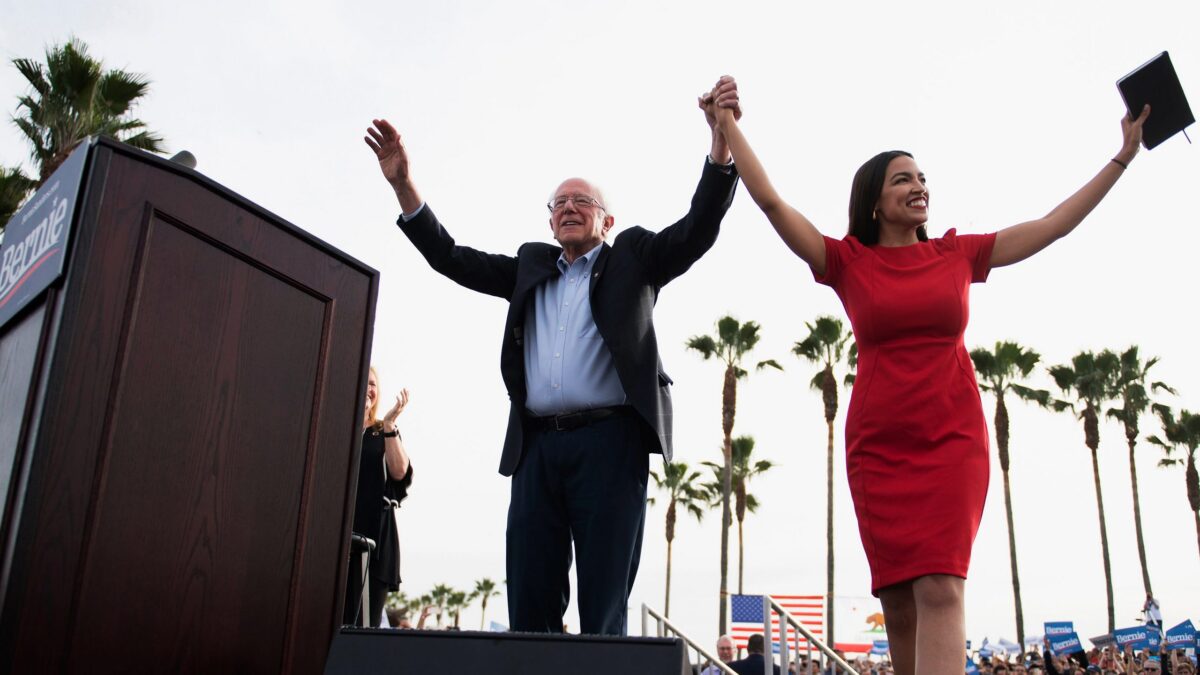
The second incident in December of 2019 that shaped the conversation was one that will be viewed as momentous if Bernie Sanders manages to win in California. That, of course, was the Venice rally that featured Sanders beside iconic Congresswoman Alexandria Ocasio-Cortez. The young New York bartender-turned-lawmaker is expected to become a powerful surrogate in Sanders’ campaign as she marshalls a nationwide moment of progressivism in which she is a leading character. In the Venice rally, Sanders attacked Buttigieg, saying “we don’t go to rich people’s wine caves.” The Sanders campaign told The Daily Mail that there were more than 14,000 people in the rally, with the palm trees framing the aging New Englander as he delivered a message to one of the largest crowds that the state has drawn this cycle.
Nobody has been more focused on California than Bernie Sanders, and the Venice rally was emblematic of that fixation. Before the end of 2019, Sanders had held 33 events in the state—more than any other candidate and 10 more than Pete Buttigieg who lags in second place with 23 events in the state, according to a tally kept by The Sacramento Bee.
In a conversation with PLAYBOY, California Congressman Ro Khanna, who is one of Sanders’ oldest surrogates said Bernie has “two major advantages coming in California; first, he was up and down, all over the state in 2016, so he had an incredible base of support and many of us who supported him in 2016, we have kept in touch with each other … so he has the largest network of grassroots support around the state. The second huge advantage he has is that he is incredibly strong with the Latino community, and this is because his message, particularly of education, of free public college and health care and on immigration resonates with that community and they trust him.”
The polling shows Biden with a whisper of a lead over Sanders in California with Warren in third and Buttigieg in a distant fourth, despite the young candidate’s frequent fundraising in the state—The Sacramento Bee’s tally shows that Buttigieg has held 42 fundraising events in California.
California might be a gold rush for the Democrats in the primary, but it’s also home to some of the most expensive media markets in the nation, which has forced candidates to get creative.
Sanders’ frequent trips to the state stand out in comparison to Joe Biden, who the Bee counted as only holding 12 events in California, but Biden has unparalleled name recognition from his long history in politics. A top Biden campaign aide noted that the former Veep “is one of two candidates who have been on the ballot before in California,” adding later, “much of his work in the Obama administration took him to California, for policy rollouts, for political reasons … we have incredibly deep roots in that state, and we’re building a very diverse coalition of support from just our voting base but also from our endorsers as well.”
California might be a gold rush for the Democrats in the primary, but it’s also home to some of the most expensive media markets in the nation, which has forced candidates to get creative. Bernie Sanders, for example, has a surprisingly attractive app aimed at getting people out to volunteer for his campaign. Asked about the problem of an expensive media market, Khanna said, “you need to have a very smart Facebook, Google, digital advertising because TV is so expensive, and then you need to target TV smartly in places and districts that you can really pick up delegates. You’re not going to be able to blanket the state.”
However, for some candidates, like billionaire Michael Bloomberg, money is not an issue. The former New York mayor has spent the entirety of his brief campaign flexing his pockets, rumors swirl in Washington D.C. about the fat salaries that his campaign dangles before operatives. In November of 2019, before he had even announced his intention to run for president, Bloomberg announced that he would spend $100 million on an anti-Trump ad campaign. Since he declared his candidacy, Bloomberg has been on television constantly, recently announcing a lucrative Super Bowl ad buy. But Christine Pelosi notes that the California voter isn’t always endeared by the candidate they see the most on television, she says “brandishing your wealth on television in California—it doesn’t necessarily equate to votes, it more equates to building a media cocoon around yourself through which it’s hard to penetrate, and I think that voters don’t necessarily like that, they like a more personal touch.”
FiveThirtyEight, a site for politics and sports number junkies, keeps a running tally of ad buys in the presidential primary and only records California ads for Bloomberg and Steyer. But those buys cost the candidates $19 million.
There is, of course, the question of how California will answer the second great referendum on progressivism that is the 2020 primary election. In 2016, the Golden State was the final defeat for Bernie Sanders. After his narrow loss, he told supporters “I am pretty good in arithmetic, and I know that the fight in front of us is a very, very steep fight.” At that moment, Sanders was almost certainly aware that the steep fight in front of him stretched into 2020.
It’s a very California thing to do to request an absentee ballot and then hold it and then take it to the polls, and like, fill it out slowly like a March Madness bracket.
Californians voting early will receive their ballots on the same day that Iowans go to the caucuses. When the new schedule was finalized in September of 2017, Democratic Secretary of State Alex Padilla said “the Golden State will no longer be relegated to last place in the presidential nominating process. Candidates will not be able to ignore the largest, most diverse state in the nation as they seek our country’s highest office.”
But even in their new moment, Californians will be watching early states like Iowa that color the candidacies of Sanders, Warren, Buttigieg and Biden. Christine Pelosi speculated “I think a lot of Californians are going to hold their votes, because it’s such a volatile time. We can start voting as soon as they start caucusing in Iowa but we’re not to do that—our ballots are going to drop but we’re not going to turn them in. Because we want to wait and see how things shake out.”
After Iowa there will be votes in New Hampshire, Nevada and South Carolina. The wizards watching the polls are united on their bets of a Biden victory in South Carolina, where he has an almost 19 point lead. But Bernie has a narrow lead in New Hampshire, a favorite state for campaign journalists and one that will dominate the news cycle when Granite State voters make their decision.
Congressman Eric Swalwell, who spent much of the first eight months of 2019 as a presidential candidate trudging through Iowa, told PLAYBOY that Californians “are not going to the polls not having thought about this. It’s a very California thing to do to request an absentee ballot and then hold it and then take it to the polls, and like, fill it out slowly like a March Madness bracket.” Swalwell added, “we won’t be ignoring what other states do but we’re very independent, we have our own needs, and we’ll be looking for candidates that speak to those needs.”
There has always been something curious about California in national politics, its distance from Washington makes it an entirely separate territory. Richard Nixon is the only American president born in California, and the Republican savior Ronald Reagan is the only other California governor to become president. But it’s also a state represented by the most powerful woman in the history of American politics: Speaker of the House Nancy Pelosi.
The 2020 race recalls the dynamic of the 2008 Super Tuesday that was the largest in primary in history. Just before voters around the nation went to the ballot box, Hillary Clinton and Barack Obama appeared on stage for the last debate in Hollywood, at the Dolby Theater, home of the Oscars ceremony. Even then, the location was a clear nod to the outsized role of California in the primary. The debate marked one of the final moments in the stand-off between Clinton and Obama, it was the first time that only the Senators were on the stage, and the tensions between their campaigns seemed to cool as Obama said “I was friends with Hillary Clinton before we started this campaign. I will be friends with Hillary Clinton after this campaign is over.”
There have been some California footnotes in the 2020 season, but none as easy to decipher as the Obama-Clinton debate in Hollywood before a Super Tuesday that saw them split delegates. In this cycle, there is of course, the launch of Kamala Harris’ campaign that was larger than Bernie Sanders’ rally on Venice beach, and there is the unsteady presence of longshot candidates like Andrew Yang—but nothing has defined California. As Super Tuesday approaches, we can expect that to change, and for some shifts in the conversation to rise from California.