Your bag is empty.
Kamala Harris managed to differentiate herself in a presidential circus. What happened?
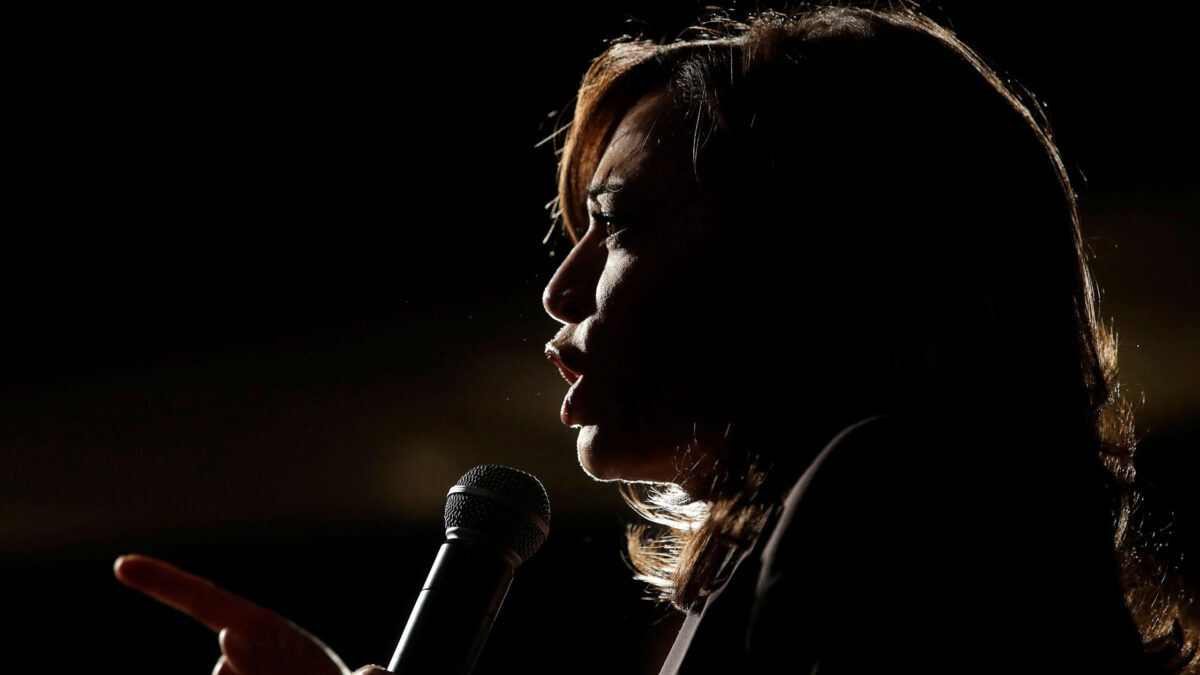
The month of November was not kind to the Kamala Harris campaign. The once-promising California senator was unable to find her way through the clouded primary field and the speculated wisdom among the political junkies was that she would not make it into the new year. A week ago, Harris announced that she was ending her campaign.
In June and July, Harris was polling in the double digits. A Quinnipac poll from July 2nd gave her 20 points—only two points behind the front-runner, Joe Biden. At the time that the poll was released, just after the first debate, Quinnipac polling analyst Mary Snow was quoted in the accompanying press release as saying “round one of the Democratic debates puts Senator Kamala Harris and former Vice President Joe Biden on two different trajectories, as support for Harris surges but continues to slip for Biden.”
But something happened to that trajectory, or maybe something didn’t. Maybe it was always heading for this broken horizon.
Biden is still polling at the top of the field, a Quinnipac poll released on November 26th shows the former vice president at 24 percent, eight points ahead Pete Buttigieg in second place. Harris sits at three percent, the same spot as Amy Klobuchar and Michael Bloomberg.
The end of the Harris campaign presents the disappointing truth that money still controls politics more than they are willing to admit.
Among the symptoms of a dying campaign is the series of articles that are written about the candidate. For Harris, this began in mid-November with a piece in Politico. The story placed the blame largely on campaign manager Juan Rodriguez and Kamala’s sister, Maya Harris. These stories seem to always run the same structure, the candidate is described as out-of-touch with the troubles of their organization. The staffers inside the campaign realize that there is something seriously wrong, but none of them want to tell the candidate. On the Harris campaign, this dynamic was complicated by the outsized role of Maya Harris, who is characterized in the stories of the downfall as an unqualified decision-maker who was slow to make any of those decisions.
In late November, The New York Times published a story that scorched the Harris campaign. The piece ran on the front page of the paper on November 30 under the headline Harris Dropped Out of Top Tier As Campaign Began to Unravel. It relied heavily on the exit of a former Harris staffer who wrote in her resignation letter, “this is my third presidential campaign and I have never seen an organization treat its staff so poorly.” Like Politico, the Times placed the blame on Maya Harris and Juan Rodriguez. The Times reporters wrote that Maya Harris “goes unchallenged in part because she is Ms. Harris’ sister” and that Rodriguez “could not be replaced without likely triggering the resignations of the candidate’s consulting team.”
Arizona Congressman Ruben Gallego, who endorsed Harris in September, says that he read The New York Times story, telling Playboy, “I think there’s always these process stories when it comes to campaigns and especially the longer campaigns are, there’s always going to be these types of stories and at the end of the day, though there might be some faults in the campaign, fundamentally, she was a very strong campaigner.”
As a candidate on the campaign trail, Kamala Harris is different than Beto O’Rourke—who announced 33 days before Harris that he was leaving the race. O’Rourke was never leading in the polls. His presence on the campaign trail confused reporters, who watched the Texan criss-crossing the country on a sort of nomadic quest. Beto seemed confused by his own momentum and was never able to harness it. That wasn’t the case for Harris.
It is hard, still, for a woman to run for president, I think it’s particularly hard for a black woman to run for president, and I think that was a big contributing factor.
Beto’s campaign began on the cover of Vanity Fair, in a story accompanied by photographs from Annie Leibovitz. Harris’ campaign began with a January rally in Oakland, attended by an estimated 20,000 people. When she emerged before that crowd, Harris played heavily on the idea that there was something truthful in her campaign, telling the crowd, “we must seek truth, speak truth and fight for the truth.” It was the sort of kick-off that promised a serious campaign and in the first 24-hours after she entered the race, the Californian raised $1.5 million.
We talk a lot about campaigns happening in the right moment. Beto’s campaign never felt to be happening in the right moment, but the moment seemed right for Kamala Harris; her first fundraising haul was evidence of that and over the next few quarters, she remained near the top of the field. But that faltered in the third-quarter of 2019—Harris brought in $11.6 million with both of the top candidates, Bernie Sanders and Elizabeth Warren, raising over $20 million.
When Kamala Harris called her aides and close supporters on December 3, she told them that she didn’t want to “bullshit” them, according to multiple people on those calls. She described making her decision at two o’clock in the morning. In an email to her closest supporters and reviewed by Playboy, Harris’ team wrote that ”Kamala is suspending her campaign today after taking a hard look at the campaign’s resources over the Thanksgiving holiday and coming to the conclusion that the financial realities of this race have made it clear the path to success in Iowa and later primary contests is not possible.”
There is no doubt that, for Harris, this was a deeply personal choice; she was the fallen front-runner with a definite political future, even if that future lies outside the White House. In our conversations on Capitol Hill, which became more infrequent after she became a candidate, Harris always seemed to be one of the more thoughtful senators. In the halls of Congress, she is smaller than she appears on the debate stage and she speaks in a cool tone that makes you feel that she is well aware of the stakes and that she is ready to confront them.
The California Senator described this choice to leave the race as the “hardest decision of her life.” On the day that she exited, Congressman Ted Lieu—who endorsed Harris in January—told Playboy, “I think she ran an amazing campaign and she is an incredible person with a very bright future ahead of her and these decisions are very personal and she made the decision based on different factors as she assessed them.”
For the moment, the Democratic field has ceased to be a campaign trail focused on the issues confronting Americans or even a trail focused much on Donald Trump. It is now a trail that is characterized by the massive bank accounts of its participants. Two billionaires—Tom Steyer and Michael Bloomberg—recently entered the race with the obvious goal of buying the Democrats’ nomination. In her email to allies, Harris’ team wrote “Bloomberg has already spent about two-times on advertising alone what Kamala raised in her entire race.”
In their conversations with Playboy, aides and people close to Harris described the death of this campaign as a financial issue. Steyer has spent over $60 million in television ads according to a report from CNBC. During his first week in the race, Bloomberg spent $57 million. It is difficult to watch television without coming across at least one of their weathered faces promising themselves as the future of America.
If there’s one thing that it presents for Democrats, the end of the Harris campaign presents the disappointing truth that money still controls politics more than they are willing to admit. Even before the polls in the early summer of 2019, Harris was ranked as a front-runner among the political junkies. Though she is only a first-term Senator, she became a national figure during the Brett Kavanaugh hearings and before that she became an icon of sorts in California. She drew frequent comparisons to Barack Obama. There was a theme that she was one of the few candidates that could actually unseat Donald Trump.
Harris called her staff in her Baltimore headquarters at 12:45 and an aide told Playboy that the candidate would release a video explaining her decision to drop out of the race. Harris posted that video at 3 p.m.—in the four-minute-long clip, she said “my campaign for president simply does not have the financial resources we need to continue. I’m not a billionaire, I can’t fund my own campaign.”
In the video and the email and the phone calls, Harris pointedly stayed away from what her next move may be. On the day after she left the race, Joe Biden was asked if he would consider Kamala Harris as a running mate; the former Vice President responded “of course I would.”
There are rumors that Harris may be preparing to run for governor, and there are rumors that she is worried about the possibility of Tom Steyer trying to take her Senate seat. The rumors of Steyer are quickly dismissed but they do raise a specific question: Why wasn’t Kamala Harris able to force a lead in her home state?
Unsuccessful presidential campaigns that move the national conscience in any direction represent something bigger than a footnote.
The California polls have largely mimicked the national polling, and Harris has not been near the top spot since the summer. Christine Pelosi, who chairs the California Democratic Womens’ Caucus told Playboy that she felt that while “many of her supporters saw her path to victory as strong in Iowa, the well-established campaign network of Biden, Sanders, Warren and the billionaires and the rise of Buttigieg left her with less opportunity for an overwhelming victory in California’s 53 congressional districts.”
Pelosi added, “for a native daughter not to place in every single congressional district would have been seen as a loss of strength and an arbitrary one at that considering that in California, we run state-wide, not by congressional districts.”
Harris always positioned herself as the native daughter. Her campaign was headquartered in Oakland and in Baltimore, Maryland. The January rally in Oakland was meant to show strength in her home state and it was a successful showing, even if it never materialized into a dominant operation in the state.
The Democrats’ eventual candidate will easily take California, a state with two Democratic senators, a Democratic governor and in which Democrats hold a supermajority in both chambers of the state legislature. But, with Harris out of the race, it will become an even fiercer battleground in the primary.
We have to consider that Kamala Harris made history. She is only the second black woman ever elected to the Senate, and she is the first black woman to ever be a top-tier presidential candidate. In our conversation, Gallego said “I think it is hard, still, for a woman to run for president, I think it’s particularly hard for a black woman to run for president and I think that was a big contributing factor.”
During the presidential debate in June that lead to her polling bump, Kamala Harris confronted Joe Biden over his history opposing desegregation bussing. She told the former Vice President “There was a little girl in California who was part of the second class to integrate her public schools, and she was bused to school every day. And that little girl was me.”
History will not forget that the little girl that Kamala Harris talked about on the debate stage became an icon. There will be the opportunity to dismiss her campaign as a footnote when the first woman is eventually elected as president, but it’s something bigger than that. Unsuccessful presidential campaigns that move the national conscience in any direction represent something bigger than a footnote and maybe that’s the biggest thing that Kamala Harris’ campaign was able to do.